The Checklist Rabbit Hole: Finding the "Goldilocks" Workflow
Some pilots obsess over their landing flair. Others obsess over the perfect headset. I, apparently, obsess over checklists.
Since day one of my flight training, I’ve had this nagging feeling that the standard, grease-stained dog-eared laminated sheet provided by the flight school wasn’t quite… it. It was a start, but it felt like trying to run a complex operation off a diner menu.
That realization triggered a journey down a rabbit hole of organization that would make a librarian blush.
The Evolution of the “Perfect” System
It started innocently enough: I created a custom version of the school’s sheet. Then, naturally, that evolved into a full-blown, multi-page laminated book covering every conceivable phase of flight.
But I soon ran into a problem. While a book is comprehensive, it can be a lot of “page-flipping” noise in a cramped cockpit. So, I pivoted to a Hybrid Approach:
-
Analog (Paper): For the pre-flight walkaround.
-
Digital (ForeFlight): For the cockpit flow.
However, even that didn’t feel right. I’m a huge believer in the Hybrid Cockpit—the idea that we should use digital for its flexibility and brightness, and analog for its bulletproof, static reliability. ForeFlight is a miracle of modern aviation, but honestly? It’s crowded. Trying to manage your plates, your map, and your checklists all on one screen feels like trying to read a novel on a ticker-tape. It’s too much information in one “home.”
The “Quick Ref” Breakthrough
The goal of a checklist is simple:
-
Safety: Close the “memory gaps” that happen when you’re tired or distracted.
-
Workload: Make the cockpit a calmer place to be.
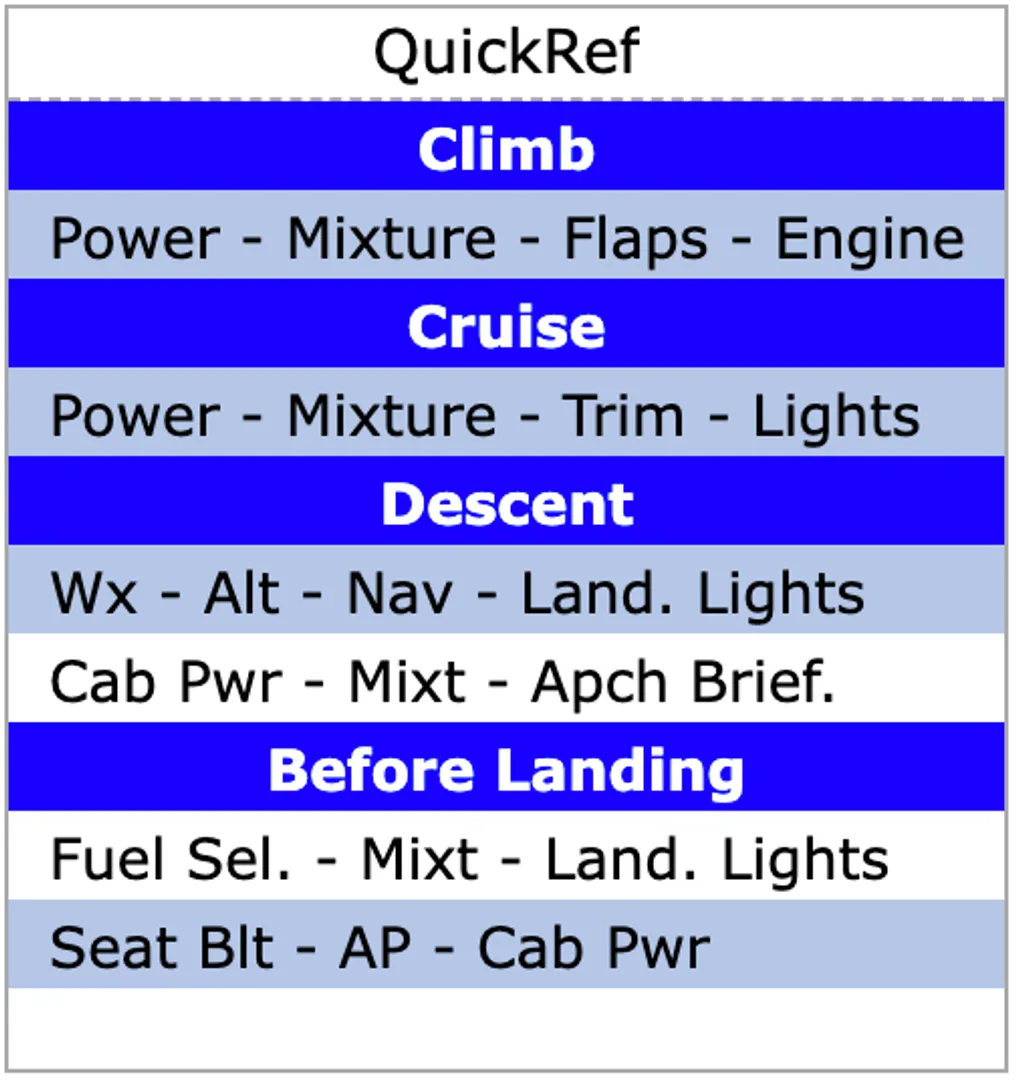
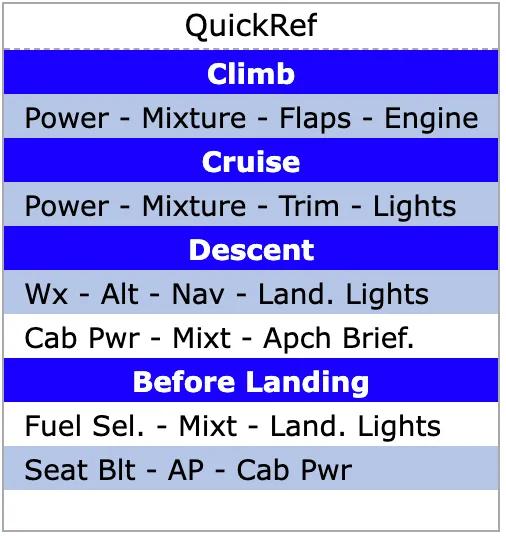
I recently added a “Quick Ref” Tile to my physical kneeboard sheet, and the boost in confidence was immediate. By baking a simple cue into my flow—running the first check the moment I receive my altitude clearance during the climb—everything just fell into place. Voila. Workload reduced. Brain space recovered.
From Sundown to Tie-down
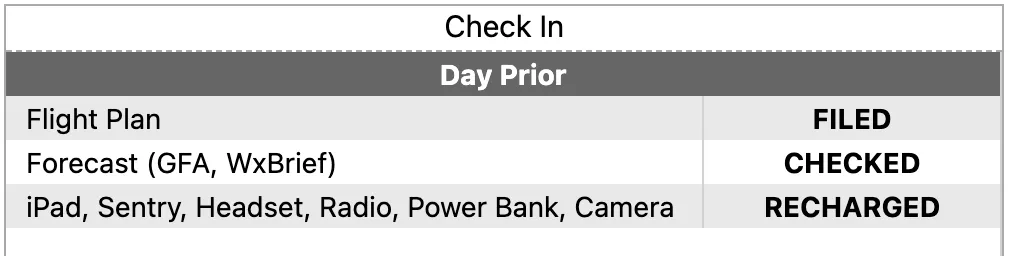
For me, the checklist doesn’t start when I sumpt the fuel; it starts the night before. I’ve developed a “Pre-Pre-Flight” routine:
-
Check Forecast (and check it again).
-
File the Flight Plan.
-
The “Charging Ritual”: iPad, Sentry, Headset, Radio, Power Bank, and Camera.
There is something deeply soothing about the final “wrap-up” checklist once the wheels are down and the chocks are in. But my favorite remains the physical, laminated pre-flight sheet. Living in the Seattle area, “waterproof” isn’t a luxury—it’s a survival trait. There is a tactile satisfaction in walking around the 172, “clicking” through the items, and knowing for a fact that the airplane is ready for me.
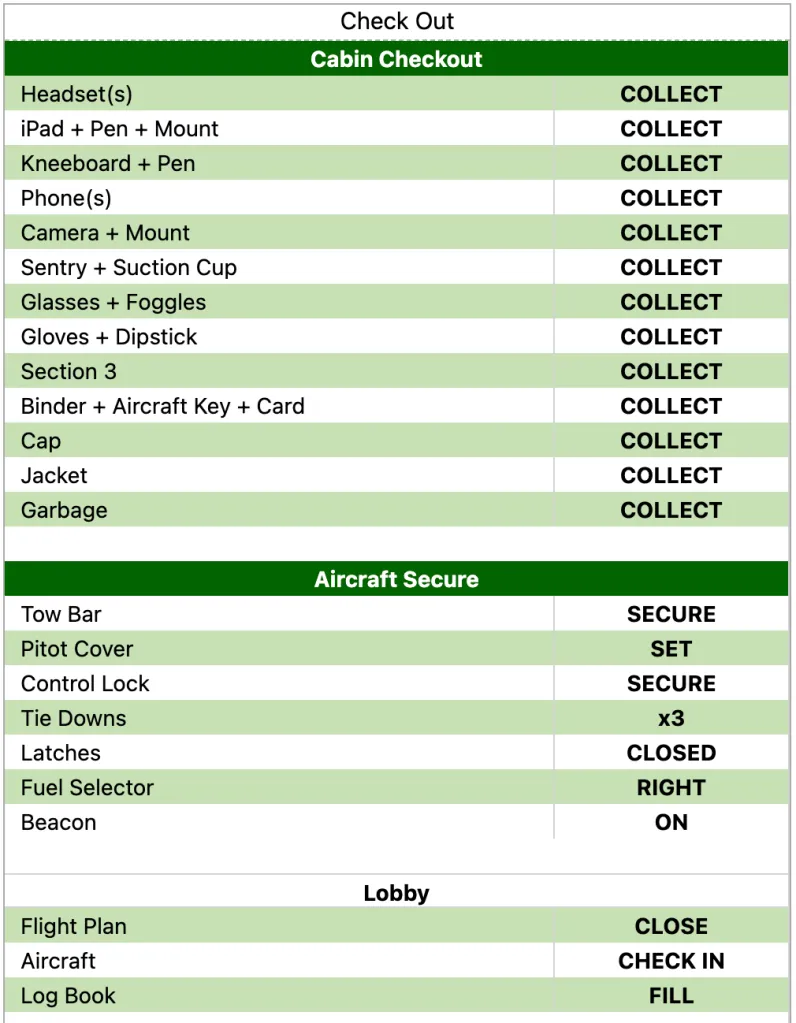
You can actually see my checklists here https://kneeboard.ga?t=JC
The Next Frontier: The Phone?
The journey isn’t over. I’m currently experimenting with a third “home” for checklists: the cell phone.
It sounds counter-intuitive to add another screen, but for specific moments—like instrument checks—having a dedicated, handheld digital source might be the missing link. My goal is to integrate this with GA Kneeboard, creating a single source of truth where the digital and paper lifecycles actually talk to each other.
Is it overkill? Maybe. But in a hobby where “forgetting one little thing” can have big consequences, I’m happy to be the guy with the laminated book and the charged-up iPhone.
How do you handle your flows? Are you a “Paper-only” purist, or is your cockpit glowing with screens?